How to Bleed Brakes (and Change Brake Fluid)
Bleed brakes and change brake fluid at home: DOT grades, testing old fluid, what carmakers say on intervals, bleed order, methods and the pedal check.
Checked against the 2026 Camry Warranty & Maintenance Guide (US) · Reviewed Nov 4, 2026 by Daniel Georgiev · 54 sources
Brake fluid takes up water, which lowers its boiling point, and carmakers set different change intervals: Toyota's 2026 US guides say inspect only, Ford's Motorcraft page says every three years, BMW of North America 36 months, then every 24 months, and ADAC every two years at the latest. Test fluid by boiling point, not pens or strips. Follow your manual's bleed order (furthest-first is only the fallback), stay within your bleeder maker's pressure limit, never run the reservoir dry, and check for a firm pedal before you drive.
Ask Rev about my car

Contents
- Brake fluid grades and boiling points
- Why brake fluid ages, even when the car sits
- How to test brake fluid
- How often to change brake fluid
- Choosing the right fluid
- Bleed order: follow your manual
- Four ways to bleed
- Never let the reservoir run dry
- When you need a scan tool
- How much fluid you need
- Bleed screws: look up your torque
- Soft pedal after bleeding?
- Before you drive
- Disposing of old fluid
- Warning signs: the red brake light
- Log it so the next one is on time
Brake fluid is the only fluid in your car that people replace based on how the pedal feels. That's backwards: by the time the pedal feels different, the fluid may already be boiling. Bleeding brakes is the natural next job after changing your pads, and it's well within reach at home. Here's how to do it properly, with each maker's figure named where makers disagree.
Brake fluid grades and boiling points
In the US, FMVSS 116 sets minimum boiling points for fresh ("dry") fluid and for fluid that has taken up water ("wet").
| Grade | Minimum dry boiling point | Minimum wet boiling point |
|---|---|---|
| DOT 3 | 401 °F (205 °C) | 284 °F (140 °C) |
| DOT 4 | 446 °F (230 °C) | 311 °F (155 °C) |
| DOT 5 (and DOT 5.1, see below) | 500 °F (260 °C) | 356 °F (180 °C) |
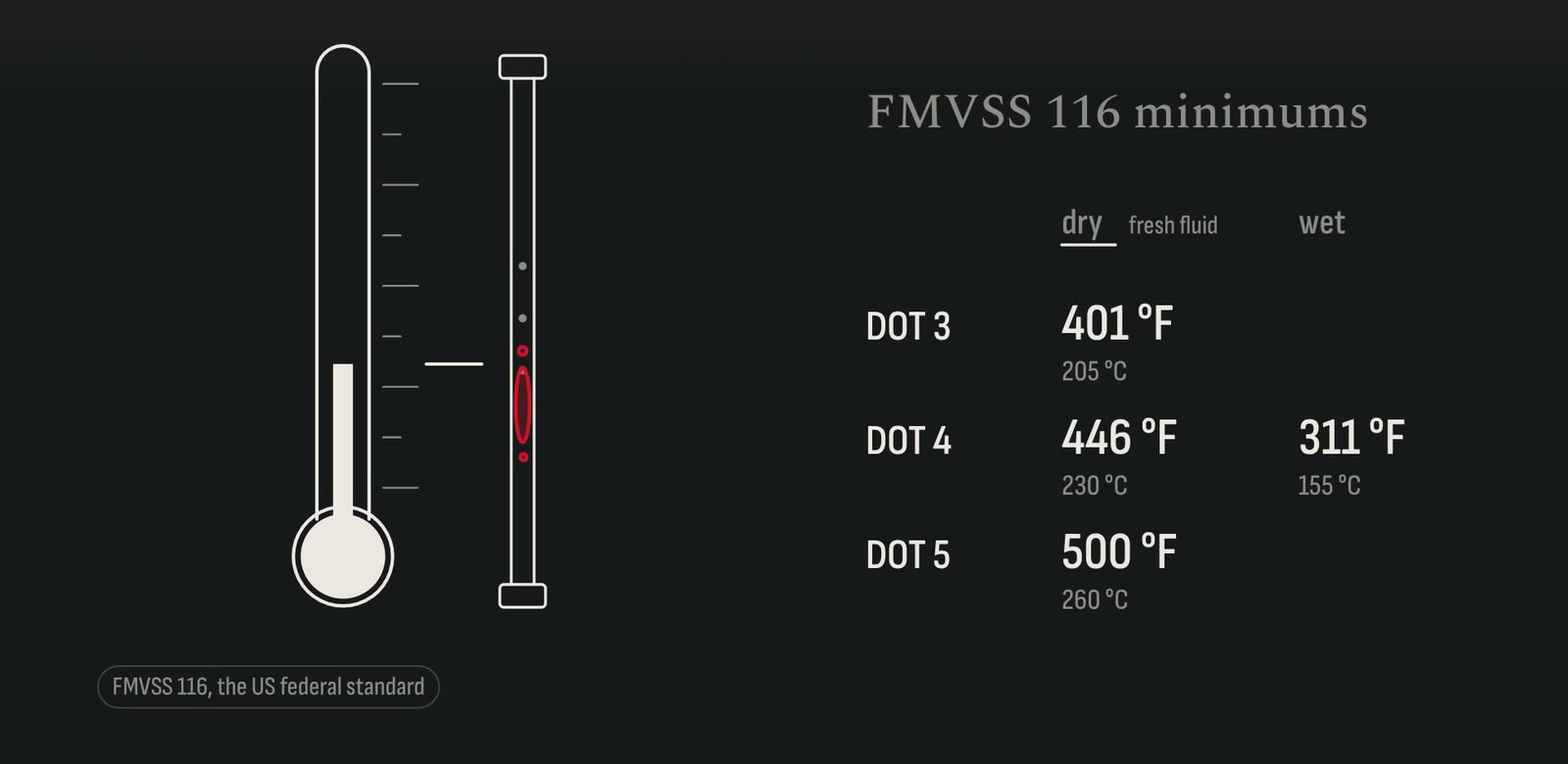
The standard's boiling-point table lists only DOT 3, DOT 4 and DOT 5. DOT 5.1 appears only in the labelling and colour rules, as "DOT 5.1 NON-SILICONE BASE". Our reading, not the standard's words, is that DOT 5.1 has to meet the DOT 5 minimums, and ATE's Super DOT 5.1 claims a wet boiling point of 356 °F, which matches.
What "wet" means. It isn't a fixed amount of water in your fluid. In the FMVSS 116 test, the sample is humidified next to an SAE TEGME reference fluid, and humidifying stops when the reference fluid reaches 3.70 ±0.05% water by weight. So "fluid is saturated at 3.7% water" is wrong: 3.70% is the reference fluid's water content, the point where the test stops.
Why brake fluid ages, even when the car sits
Fresh fluid starts almost dry: ZF puts average fluid at about 0.05% water, and Eurol's lab tests found fresh fluids averaged 0.1%. Water gets in through the reservoir cap's vent hole, from humid air and from engine or car washing, and by diffusing through hoses and seals. None of that needs the car to move.
How fast depends on who you ask. Bendix (Australia) says about 2% water after one year in service and more than 3% after 18 months, faster at 35 °C and up with 90% humidity. ZF says that once water passes 3%, the boiling point falls to about 140–180 °C.
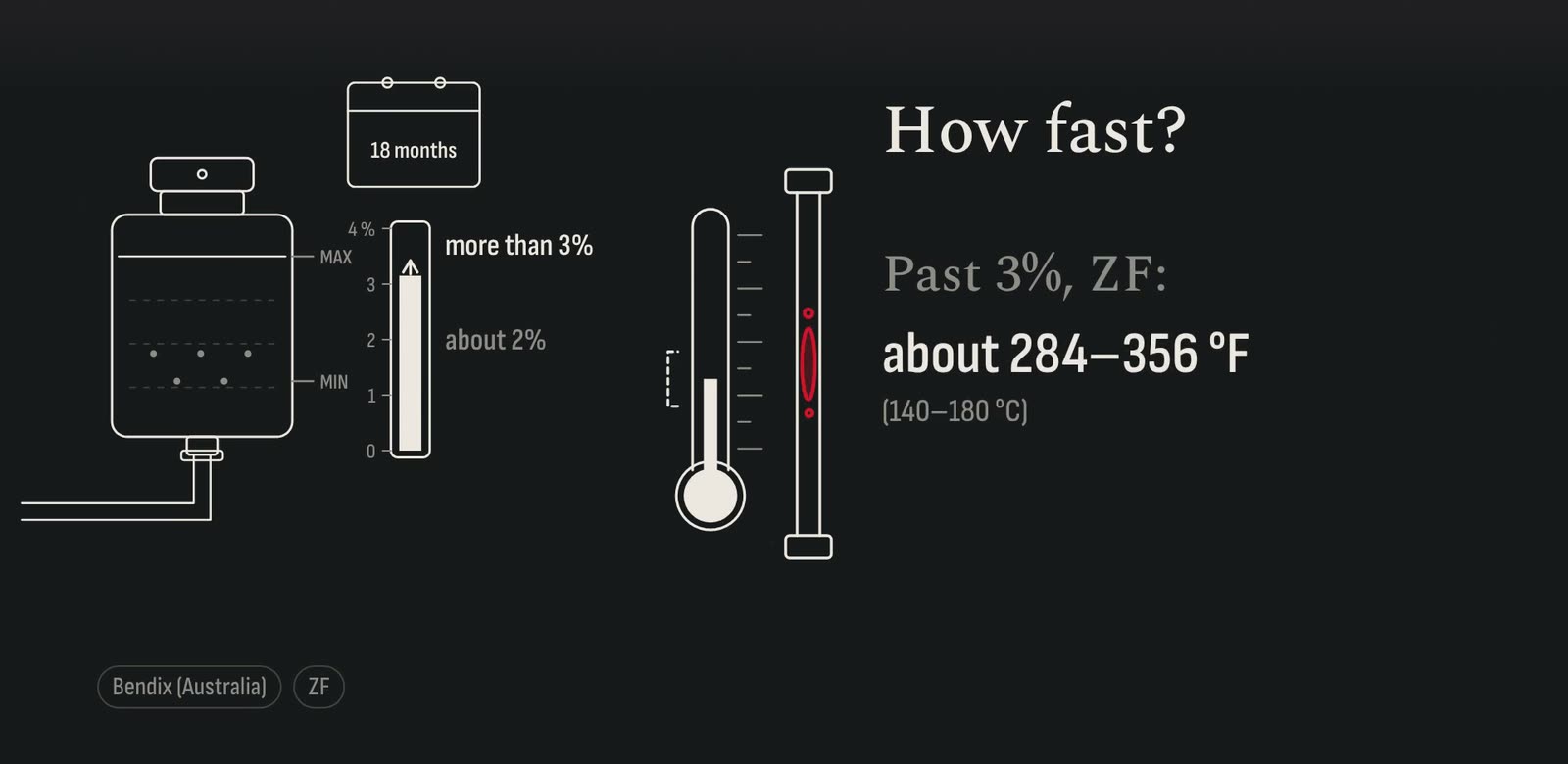
That matters because of vapour lock. Brembo explains that the water lowers the boiling point, and under heavy heat the fluid boils into vapour bubbles: the pedal goes soft, travels further and braking force drops, especially after a long downhill. ATE says that in the worst case the pedal drops to the floor. And the reservoir can't warn you: ADAC says the level shows how much fluid is in the system, not how old it is. If the level does drop, Honda's Civic manual says that at or below MIN, a dealer should inspect the car for leaks or worn brake pads.
How to test brake fluid
Three kinds of tester are sold, and they don't measure the same thing.
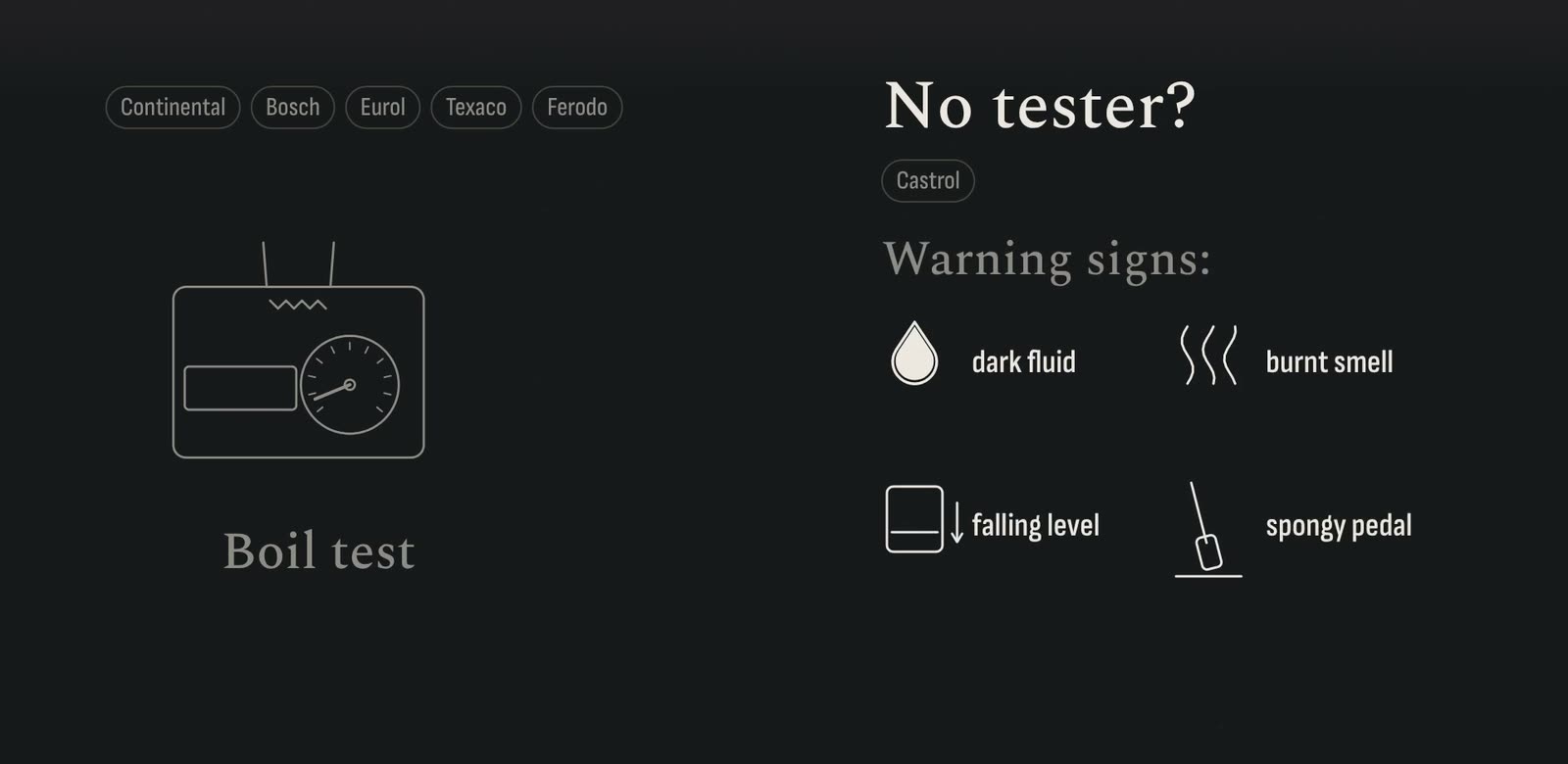
Boiling-point testers heat a sample and read the temperature. Continental calls boiling "the only way to determine the exact boiling point", and Bosch says the same of its BFT 100, which shows "replace fluid" when the reading falls short of the grade's minimum. Texaco (Chevron) concludes: "Testing the boiling point remains the approved method".
Conductivity pens are less reliable. In Eurol's tests on DOT 4, two gauges gave different readings on the same retested sample, and some of the water Eurol added (up to 6%) didn't show up at all. Texaco reports cases where they flagged fresh, in-spec fluid as wet. According to Ferodo, pens can fail new fluid and pass contaminated fluid, because conductivity varies by maker, batch and grade.
Test strips don't measure water at all. Phoenix Systems, which sells them, says "BrakeStrip is a copper test, NOT a moisture test", and its own blog calls copper a lagging indicator.
The verdict: Continental/ATE, Bosch, Ferodo, Eurol and Texaco all favour the boiling test. Without a tester, watch for the signs Castrol lists: dark fluid, a burnt smell, a falling level and a spongy pedal.
How often to change brake fluid
There's no single interval. Here's what each maker actually prints:
| Maker | What it says | Where |
|---|---|---|
| Toyota (2026 RAV4, Camry, Tacoma, 4Runner, US) | Inspect "brake fluid level/condition" every 5,000 miles; no replacement interval | Warranty & Maintenance Guides |
| Lexus (2026 RX 350, IS 350, US) | Brake fluid marked replace: once in the 5,000–50,000-mile chart, twice in 55,000–100,000 and twice in 105,000–150,000 | Warranty and Services Guides |
| Toyota Europe (RAV4 and Yaris 2017, Auris 2013) | Replace every 24 months | Maintenance schedules |
| Ford | "Recommended service (change-out interval) is every three years." | Motorcraft DOT 4 LV product page |
| BMW of North America (2–7 Series, M models) | First change at 36 months (about 30,000 miles), then every 24 months | CBS interval table (2018) |
| Chevrolet (2016 Tahoe) | "Change brake fluid (or every 3 years, whichever occurs first)" | Maintenance schedule |
| ADAC (German auto club) | Every two years at the latest, whatever the mileage | Brake fluid advice page |
| Tesla Model 3 | Check brake fluid health every 4 years; replace if necessary | Owner's manual |
Fluid and parts makers spread even wider: ZF/TRW says every year regardless of mileage, Bosch says DOT 4 every 2 years or 40,000 km, and ATE says its TYP 200 fluid lasts up to three years in normal highway driving.
Check your own owner's manual or maintenance guide, and go by that. If it says inspect only, test the fluid: according to Ferodo, the change should be based on a test, not on the car's mileage or age. More on the reasoning in our brake fluid interval explainer.
Choosing the right fluid
- Read the reservoir cap. Ford says to check the cap and the owner's manual for the right fluid, and ADAC says to use only the grade the carmaker specifies.
- DOT 4 LV where the carmaker calls for it. Low-viscosity DOT 4 is made for cars with ESP/ABS/ASR, and Motul says it flows better through the ABS micro-valves. Ford recommends Motorcraft DOT 4 LV for ABS systems with stability control, but says it is not for vehicles that specify DOT 5.1 or "SUPER DOT 4". A bigger number isn't automatically the right fluid.
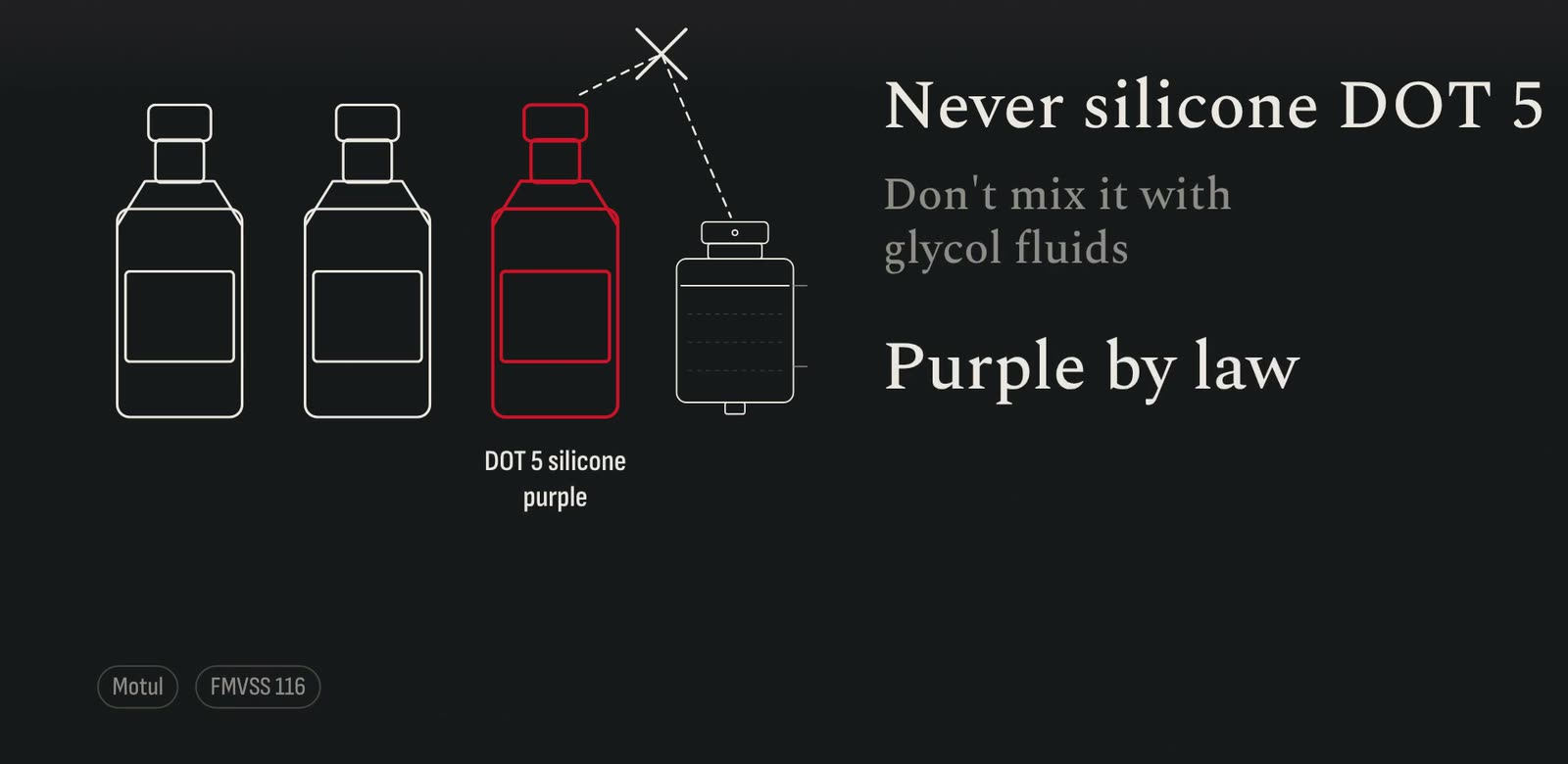
- Never mix in silicone DOT 5. Motul says its glycol fluids mix with other non-silicone DOT 3, DOT 4 and DOT 5.1 fluids, but warns: "Do not mix with silicone (DOT 5 silicone base)." ADAC says not to mix fluids at all. Silicone DOT 5 is easy to spot: by law it must be purple, while DOT 3, DOT 4 and DOT 5.1 must be colourless to amber.
- Use a sealed bottle. ADAC says not to reuse opened bottles, because they may already have taken up water. One of the label warnings FMVSS 116 requires reads "KEEP BRAKE FLUID CLEAN AND DRY."
- Protect your paint. Motul calls it an "Aggressive chemical product if contact with hands, paint or varnish," and ADAC says to wipe up spills at once. Tesla says to keep water and clean towels ready.
Some carmakers don't want owners in the system at all: Tesla tells Model Y owners not to top up the brake fluid themselves.
Bleed order: follow your manual
The classic shop rule is furthest from the master cylinder first. Brake Parts Inc gives it as longest line to shortest, which on most vehicles means right rear, left rear, right front, left front, but adds that this may not be right for every vehicle and that diagonal-split front-wheel-drive cars use an order that varies by carmaker.
Others go a different way. Tesla's Model 3 and Model S manuals start front left, front right, rear right, rear left. Bosch's brochure says: "Start brake bleeding at the wheel located the closest to the brake master cylinder." ATE's bleeder manual says the carmaker's bleeding instructions "must always be observed and followed", and Motive says to take the order from the service manual.
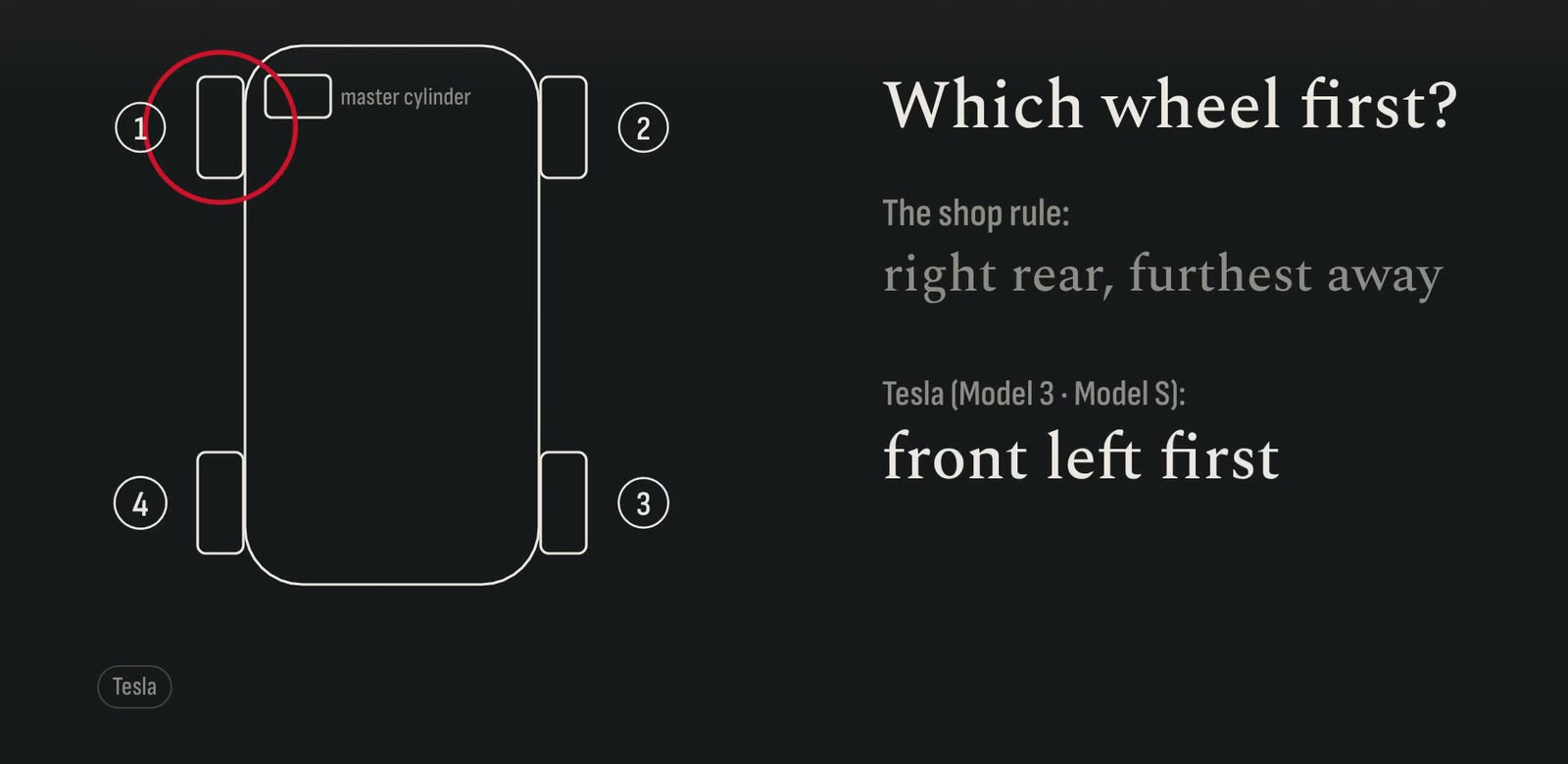
So follow your manual's order, and fall back on Brake Parts Inc's furthest-first order only when you can't find one. Two-screw calipers are the same story: Wilwood says outboard first, Brake Parts Inc says inboard first.
Four ways to bleed
Brake Parts Inc lists four methods: gravity, manual, pressure and vacuum.
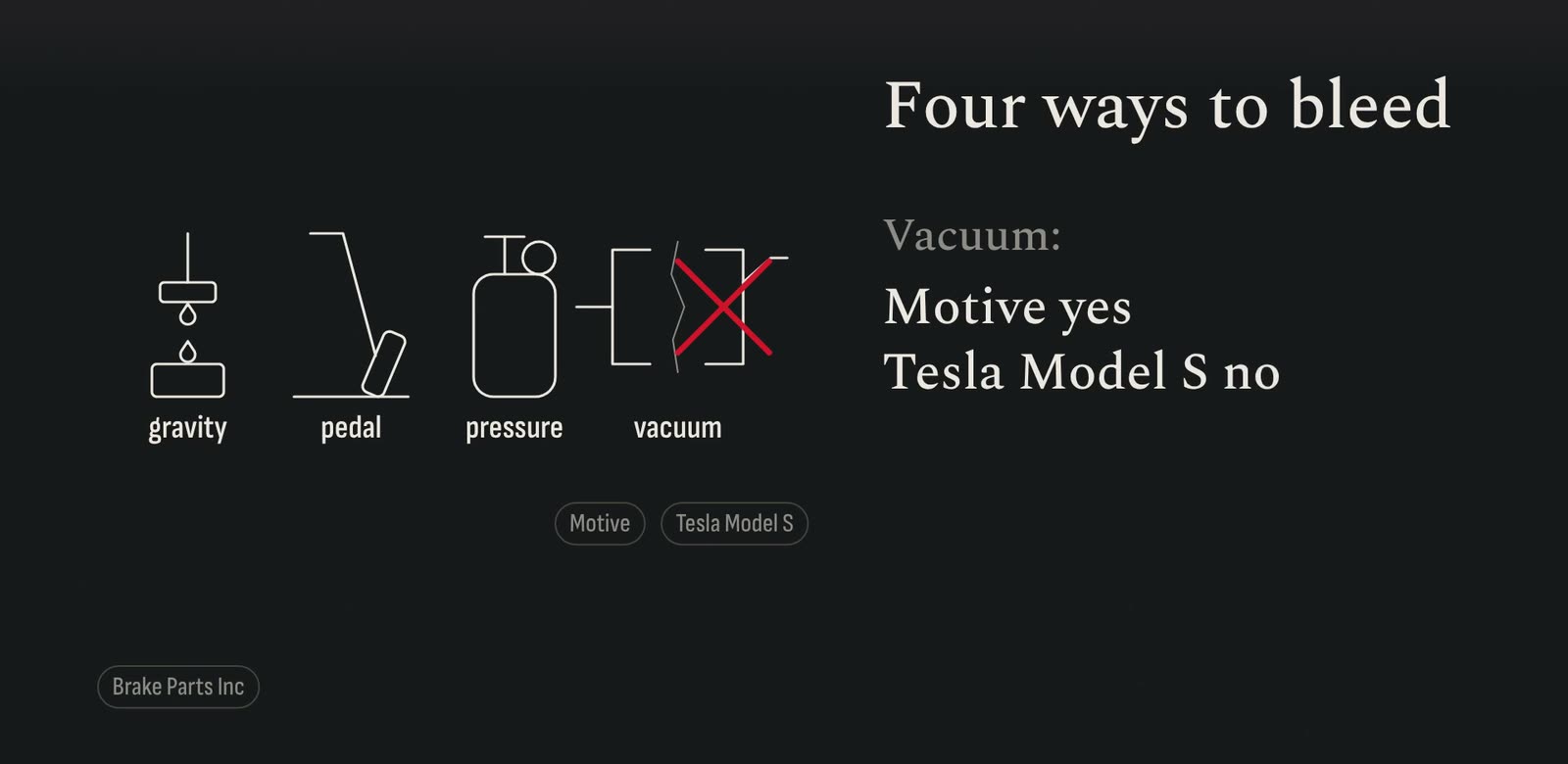
Gravity. Open the bleed screw and let fluid run down to the caliper.
Manual. The most common: the pedal and master cylinder are the pump, with smooth strokes so the fluid doesn't foam. Tesla's Model S step: the assistant holds the pedal down, you open the bleed nipple a quarter turn and close it before the pedal is released, 5 times per nipple. Put a block of wood under the pedal so an old master cylinder piston never travels into the unused end of its bore. A one-way-valve catch bottle lets you do it alone.
Pressure. A tank on the reservoir pushes fresh fluid through, so it's a one-person job and the reservoir stays fed. There's no single right pressure:
- Motive: 15 psi (50 to 70 pumps), and "do not exceed 30 psi."
- Phoenix Systems: 15–20 psi typical, 10–12 psi to start if the manual gives no figure, and 20 PSI as the ceiling unless the manual says otherwise; too much can blow out master cylinder seals.
- Bosch: 0.5–2 bar (7.25–29 psi), as the carmaker specifies.
- Tesla Model S: 30 PSI (2.07 bar).
Bosch and Phoenix both defer to the carmaker's figure, so use yours where the manual gives one. If you'll do this job more than twice, a pressure bleeder is worth buying.
Vacuum. Pulls fluid and air out at the bleed screw. It also draws air past the threads, so a stream of tiny bubbles tells you little; grease on the threads helps. Motive says its vacuum tool should not exceed 15 inHg. Tesla's Model S procedure rules it out: "Do not use a vacuum bleeder."
Whatever the method, run each corner until the fluid comes out clear and free of bubbles.
Never let the reservoir run dry
ATE: "The braking system cannot function if the brake fluid reservoir has been drained!" Tesla's Model 3 manual says to top up to MAX after each caliper, and if the reservoir goes empty, to refill it and repeat the entire procedure. Phoenix Systems says a dry reservoir "introduces a huge air bubble" that can get trapped inside the ABS/ESC hydraulic unit, where a caliper-only bleed may not clear it; the signs are a low or mushy pedal and an ABS or ESC light that stays on.
When you need a scan tool
It depends on the car. Brake Parts Inc says some ABS cars bleed by hand, some by pressure, and some "require a scan tool to activate the pump or solenoids."
- Saab 9-4X: a scan-tool "automated bleed" when normal bleeding doesn't give the right pedal height or feel, after heavy fluid loss, or if air may be in the modulator's internal circuits. The tool cycles the valves and runs the pump, then the system is pressure-bled again.
- Tesla Roadster: use the diagnostic tool if the ABS modulator or master cylinder was removed, or if a firm pedal can't be reached.
If you ran the reservoir dry, replaced a hydraulic part or can't get a firm pedal, your car can need one. ZF's TRW adds that calipers with an electric or mechanical parking brake can take several bleeding attempts. Use a scan tool that runs your car's ABS bleed routine, or have a shop do that step. Driving on a soft pedal is not an option.
How much fluid you need
Bosch says at least 3 litres in the pressure bleeder and about 250 ml at each wheel. ADAC puts the whole system at about 2 litres. Tesla says its Model S procedure "requires a significant amount of fluid".
Bleed screws: look up your torque
Bleed screw torque depends on the caliper. Tesla's figures show how much it varies on one maker's cars:
| Tesla caliper | Bleed screw torque |
|---|---|
| Model 3 front, Mando | 7.4 lb-ft (10 Nm) |
| Model 3 front, Hitachi | 8.8 lb-ft (12 Nm) |
| Model 3 front, Brembo | 13.6 lb-ft (18.5 Nm) |
Look up yours and use a torque wrench that reads that low. Overtightening is how screws snap on the next fluid change.
Seized screws are the other snag. Soak them in penetrating oil the day before, use a 6-point socket or box-end wrench, and crack them loose with a short, sharp push. If the flats start rounding, stop. Motive says to replace bleeder screws that are rounded off, seized, corroded or weeping fluid at the threads. Refit the dust caps when you're done.
Soft pedal after bleeding?
- Air. Wilwood says a pedal that goes spongy after resting means air is still in the system, and ATE says to bleed again, following the carmaker, if pedal travel is too long.
- Vapour lock. After hard use, Brembo's explanation is boiling fluid, and the fix is a complete bleed with new fluid. Fade is different: overheated pads give a spongy pedal and a burning smell.
- Hoses. Ferodo says a hose that leaks or balloons under pressure gives poor pedal response, and that some makers recommend new hoses after "30,000 miles or at least every 5 years".
Before you drive
Wilwood: "DO NOT OPERATE ANY VEHICLE ON UNTESTED BRAKES!"
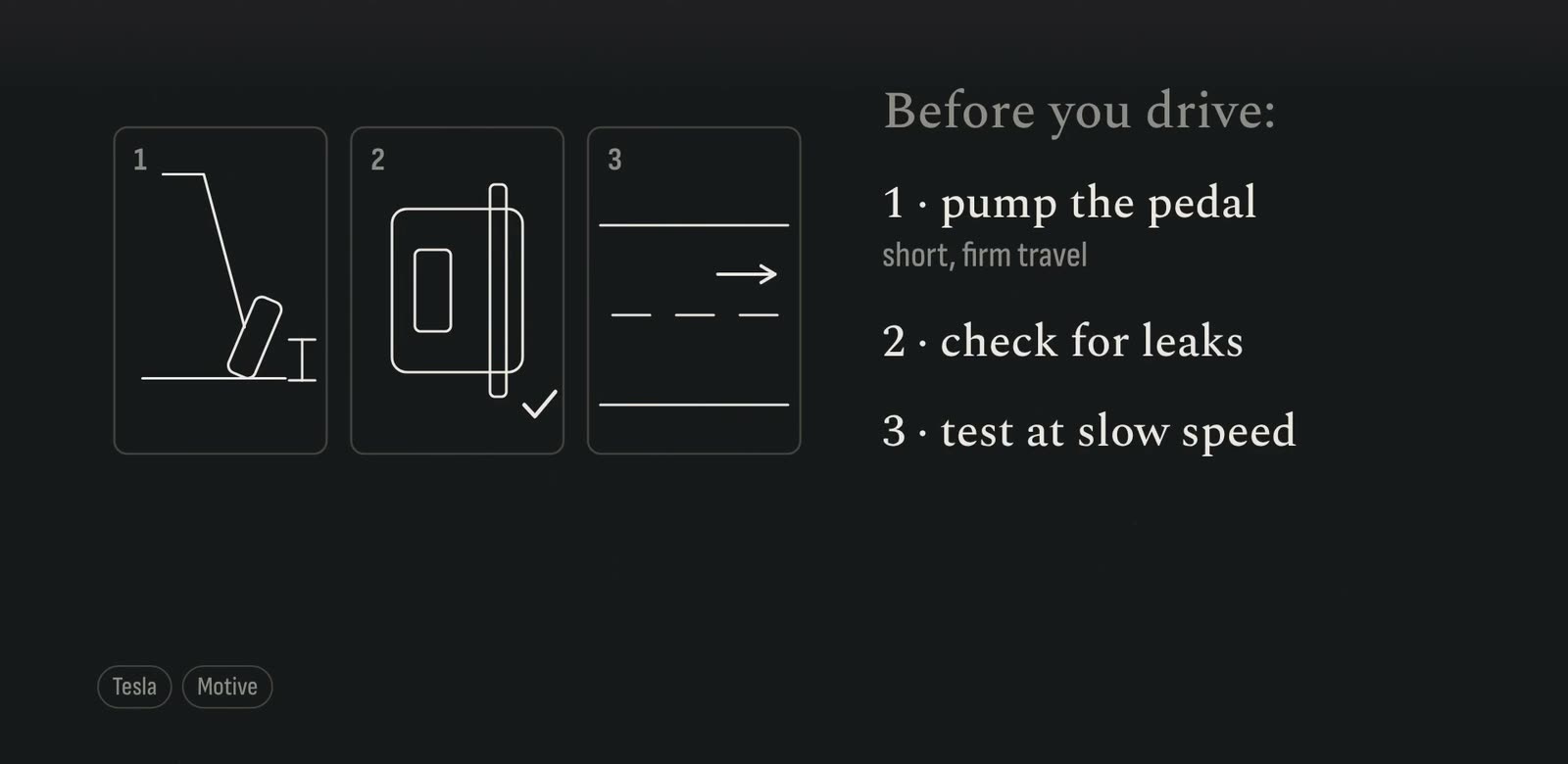
- Pump the pedal, engine off. Tesla says to look for short, firm travel. Spongy or sinking means air.
- Engine running. The pedal drops slightly as the booster assists, then holds firm.
- Hold it. Press hard for 30 seconds. The pedal must not creep toward the floor.
- Check for leaks. Motive says to check the calipers for leaks. Wipe each screw dry and confirm it stays dry, and check the fluid is "between the min and max indicators" (Brembo).
- Test at slow speed. Motive's last step, on a quiet street before you rejoin traffic.
Disposing of old fluid
ATE says to collect it in its own container, never mixed with other fluids, and take it to a certified waste or recycling facility. Bosch says specialised waste facilities only, and Tesla says follow local environmental codes.
Warning signs: the red brake light
What it means depends on the car, so read your manual's page on it.
- Mazda (2025 CX-50, US): low brake fluid or an EBD fault. Park somewhere safe immediately: "Do not drive with the brake system warning light illuminated."
- Ford: the parking brake on while moving, a brake fault or low fluid. "Driving your vehicle with the warning lamp on is dangerous."
- Volkswagen UK: low brake fluid. Stop as soon as it's safe and check the level: "Do not drive on!"
ADAC notes that a low fluid level can itself cause brake failure.
Log it so the next one is on time
Then close the loop: log the change in GarageHub with the date, mileage and fluid spec, and set a reminder for the interval your manual gives. Or tell Rev, GarageHub's AI mechanic, what you did, and it writes the record for that car.
Frequently asked questions
How often should brake fluid be changed?
It depends on the car, so check your owner's manual or maintenance guide. Toyota's 2026 US guides for the RAV4, Camry, Tacoma and 4Runner say inspect only, with no replacement interval, while Lexus's 2026 US guides mark it for replacement and Toyota Europe's schedules say every 24 months. Ford's Motorcraft DOT 4 LV page says every three years, BMW of North America says 36 months, then every 24 months, and the 2016 Chevrolet Tahoe schedule says every 3 years. Germany's ADAC says every two years at the latest, and Tesla's Model 3 manual calls for a brake fluid health check every 4 years.
Which wheel do you bleed first?
The one your car's manual says. The classic order, from Brake Parts Inc, is longest brake line to shortest: right rear, left rear, right front, left front on most vehicles. But Tesla's Model 3 and Model S manuals start at the front left, Bosch's brochure says to start at the wheel closest to the master cylinder, and diagonal-split front-wheel-drive cars vary by carmaker. Use furthest-first only as the fallback.
Can you mix DOT 3 and DOT 4 brake fluid?
Motul says its glycol fluids can be mixed with other non-silicone DOT 3, DOT 4 and DOT 5.1 fluids, but ADAC says to use only the grade the carmaker specifies and not to mix fluids or switch types. Never mix in silicone DOT 5, which by law must be purple. Go by your reservoir cap and owner's manual.
How do you know if brake fluid is bad?
Test its boiling point. Continental/ATE, Bosch, Eurol, Texaco and Ferodo all favour boiling-point testers. Conductivity pens can misread: Texaco reports them flagging fresh fluid as wet, and in Eurol's tests some added water didn't show up. Test strips measure copper, not water. Castrol lists dark fluid, a burnt smell, a falling fluid level and a spongy pedal as warning signs.
Do I need a scan tool to bleed brakes on a car with ABS?
It depends on the car. Brake Parts Inc says some ABS cars bleed by hand, some by pressure, and some need a scan tool to activate the pump or solenoids. Saab's 9-4X manual calls for a scan-tool bleed after heavy fluid loss, when air may be in the modulator, or when normal bleeding doesn't give the right pedal. Tesla's Roadster needs one after the ABS modulator or master cylinder is removed, or when a firm pedal can't be reached.
Why is my brake pedal still soft after bleeding?
Usually air still in the system: Wilwood says a pedal that goes spongy after resting means air remains, and ATE says to bleed again, following the carmaker. Other causes are a hose that leaks or balloons under pressure (Ferodo), or air trapped in the ABS/ESC unit after the reservoir ran dry (Phoenix Systems), which on some cars needs a scan-tool bleed. Don't drive on a soft pedal.
Sources
- 49 CFR § 571.116 — Standard No. 116; Motor vehicle brake fluids
- 0100 European Power Bleeder — One-Person Brake Bleeder
- 49 CFR 571.116, Standard No. 116; Motor vehicle brake fluids (eCFR, current)
- Press release 2022-06-21, ATE brake fluids engineered for quick response and reliability in all types of brake systems
- Timely reminder on brake fluid life span as summer approaches
All 54 sources
- Press release 2020-01-14 on brake fluid change (release 13965)
- Brake fluid change (press release PDF, dated 2019-12-18)
- How can you measure the quality of brake fluids?
- Motul DOT 4 LV technical data sheet (dated 2020-10-28)
- Motul DOT 5.1 technical data sheet (dated 2025-09-11)
- Motorcraft DOT 4 LV High Performance Motor Vehicle Brake Fluid (PM-20) product details
- Bremsflüssigkeit: Wozu man sie braucht, was ein Wechsel kostet
- Press release 2017-09-01, "Brake safely" (ATE BFCS 300 boiling-point tester)
- Braking: BFT 100 brake fluid tester (leaflet, French)
- How manual electronic measuring devices ensure accuracy and safety for brake fluids
- Technical Tips: Brake vapour lock No. 2 (PRMFE1025-UK) (maker leaflet on trade mirror)
- What is BrakeStrip? (for its own product)
- The copper trap: why brake fluid test strips don't tell the whole story (blog)
- 2026 Camry Warranty & Maintenance Guide (US)
- 2026 Tacoma Warranty & Maintenance Guide (US)
- 2026 4Runner Warranty & Maintenance Guide (US)
- 2026 RAV4 Warranty & Maintenance Guide (US, pub. T-MMS-26RAV4HV)
- 2026 Lexus RX 350 Warranty and Services Guide (US, pub. L-MMS-26RX350)
- 2026 Lexus IS 350 Warranty and Services Guide (US, pub. L-MMS-26IS350)
- Maintenance Schedule, Europe: RAV4 (dated 21/08/2017)
- Maintenance Schedule, Europe: Yaris / Yaris HV (dated 22/08/2017)
- Maintenance Schedule, Europe: Auris / Auris HSD (dated 14/02/2013)
- 2018 Condition Based Service (CBS) intervals, Attachment 2 to SI B000217 (July 2020)
- 2016 Chevrolet Tahoe maintenance schedule
- Civic Sedan Owner's Manual: Brake/Clutch Fluid (pub. AT202323IOM)
- Importance of changing brake fluid (Castrol FastScan, South Africa)
- Data sheet DS793: Combination proportioning valve (incl. bleeding notes)
- Model 3 (2017-2023) Service Manual: Brake Fluid Bleed/Flush
- Model S (2012-2020) Service Manual: Bleed or Flush Procedure - System
- Brake fluids brochure (incl. fluid change and bleeding steps), code AA/MBC2 DE 2022/8
- Brake Bleeding (technical PDF)
- ATE FB 30 brake bleeding device: operating instructions (ATE document on distributor host)
- Power Bleeder Owner's Manual & Safety Instructions, Revision 4
- Model S Service Manual: Bleed Procedure - One Caliper
- How to adjust pressure settings on a pressure brake bleeder
- How to use a brake bleeder on cars with ABS
- Saab 9-4X (2011) WIS: Antilock brake system automated bleed (OEM workshop text on an unofficial mirror site)
- Roadster Service Manual: Brake System Bleed Procedure
- TRW pre-filled brake calipers (workshop tip)
- Motive Products home page
- Brake fading and vapour lock: two problems compared
- Brake fluid brochure
- Tech tip: Spongy or soft brake pedal (Ferodo-branded; page does not name the brand owner)
- Model 3 Owner's Manual: Maintenance Service Intervals
- 2025 Mazda CX-50 Owner's Manual: Brake System Warning Light
- What do the warning and indicator lights in my Ford mean?
- Model Y (US): Checking Brake Fluid
- Low brake fluid level (warning light)
- Noises and vibrations
Intervals vary by market, engine and driving conditions; your owner's manual is the authority for your car.
Keep reading


Keep this job in your service history
Rev knows your car, your parts and every job you've logged. Ask a question and get an answer for your car, not a forum thread about someone else's.